Where is your operation, honestly?
Every organization has processes. The question is whether they exist on paper, live in a manager's head, or depend entirely on whoever happens to be working that day — and what that costs in revenue, capacity, service quality, consistency, and trust.
Our Five-Stage Operational Maturity Model
Whether you run a service business, a contact center, or a public-sector department, critical operations tend to mature along the same path. Not every task needs to reach Stage Five — the goal is to move the customer and resident journeys that matter most toward a level where performance is consistent, measurable, and resilient.
Heroic
It works because certain people care enough to make it work. Nothing is clearly documented, and performance depends on who happens to be working that day.
The tell: when your best person is out, everything slows down.Documented
Someone wrote down the process. It lives in a binder, shared drive, training deck, or onboarding packet that employees stopped using after their first week.
The tell: ask three people how the same task should be handled and receive three different answers.Followed
The process is followed — but primarily when a manager is watching. Compliance depends on supervision rather than being built into the operation.
The tell: quality drops on nights, weekends, and whenever the supervisor is unavailable.Measured
Performance is scored against a defined standard. Coaching is based on observed behavior and measurable outcomes — not simply a manager's opinion.
The tell: you can name your response time, resolution rate, conversion rate, quality score, or service level — with an actual number.Self-Correcting
The system surfaces failures before the customer or resident does. Measures trigger action, technology supports the standard, people continuously improve it, and the process survives turnover.
The destination: critical work performs consistently without depending on one person's presence.The dangerous gap is believing you operate at Stage Three while your customers, residents, or employees experience Stage One.
Hero thinking versus system thinking.
Most operations do not remain stuck because people are unwilling to work. They remain stuck because recurring problems are solved by searching for a better person instead of building a better process.
Hero thinking
- Makes one person exceptional while leaving the operation dependent on them
- Easy to celebrate but difficult to replicate
- Allows knowledge to leave when the employee does
- Makes quality depend on who answered the call or handled the request
- Treats the same symptoms repeatedly without correcting the cause
System thinking
- Makes capable employees consistent and top performers exceptional
- Requires deliberate design and clear standards
- Allows knowledge to outlive individual employees
- Creates a dependable minimum standard across employees and shifts
- Corrects recurring causes instead of repeatedly managing the same symptoms
When your only quality backstop is whichever supervisor happened to be listening, consistency depends on chance. A defined standard creates a dependable foundation — while still allowing employees to use judgment when the situation requires it. Quality becomes a floor, not a lottery.
Why the process comes first.
You cannot hire your way out of a broken process. You cannot train people into an undefined one. You cannot coach consistently against an undefined standard, and you cannot automate chaos — technology only scales whatever already exists, good or bad.
That's why the order is Process, then People, then Technology. Define what good looks like, develop the people who execute it, then deploy the tools that make it repeatable at scale. Skip the first step and the other two just make the mess move faster.
The audit identifies which gaps are driving the problem, how they connect, and the order in which they should be addressed.
Start with a 30-minute discovery call.
The call is the starting point — not the audit. In thirty minutes we identify the customer or resident journey worth examining, the symptoms you're seeing, the outcomes that matter, and whether a formal audit is likely to help.
Book the Discovery CallWe'll tell you honestly when a formal audit, training program, technology solution, or consulting engagement is not the right next step.
The Customer Journey Audit.
When deeper work is warranted, the Customer Journey Audit examines the operation behind the experience: the processes employees follow, the capabilities they need, the way supervisors coach, the measures leadership uses, the handoffs between teams, and the technology supporting the work.
The audit follows the customer or resident journey from the first point of contact through the relevant outcome — whether that's a purchase, resolution, service delivery, follow-up, renewal, or continued relationship. Depending on the operation and the agreed scope, we may review:
- ◆Customer or resident calls, chats, emails, forms, and other interactions
- ◆Current workflows, handoffs, escalation paths, and ownership
- ◆Standard operating procedures, scripts, job aids, and training materials
- ◆Quality standards, coaching practices, and supervisor routines
- ◆Response time, resolution, conversion, transfer, escalation, and satisfaction measures
- ◆The systems and technology employees use to complete the work
- ◆Interviews with frontline employees, supervisors, and leadership
- ◆Where employee judgment is required — and where clearer standards are needed
We compare what leadership believes should happen, what the documented process says should happen, what employees are actually doing, and what the customer or resident ultimately experiences.
What You Receive
The findings are delivered in a consolidated written audit report, followed by a leadership readout to review the evidence, priorities, risks, and recommended next steps.
Training — prescribed, not assumed.
Not every performance problem is a training problem. Training cannot correct an undefined process, conflicting expectations, broken handoffs, or technology that makes the work harder. But when the process is clear and the audit identifies a real capability gap, we build the skills needed to execute it.
We deliver support at any appropriate scope: a focused workshop, a team-development program, or a complete training system with standards, facilitator materials, coaching tools, and reusable curriculum. Programs may include:
Many programs are built on Patrick Arcement's published frameworks — Sales Linkage for consultative sales and objection handling, and AF² for coaching and leadership development.
The audit comes before automation.
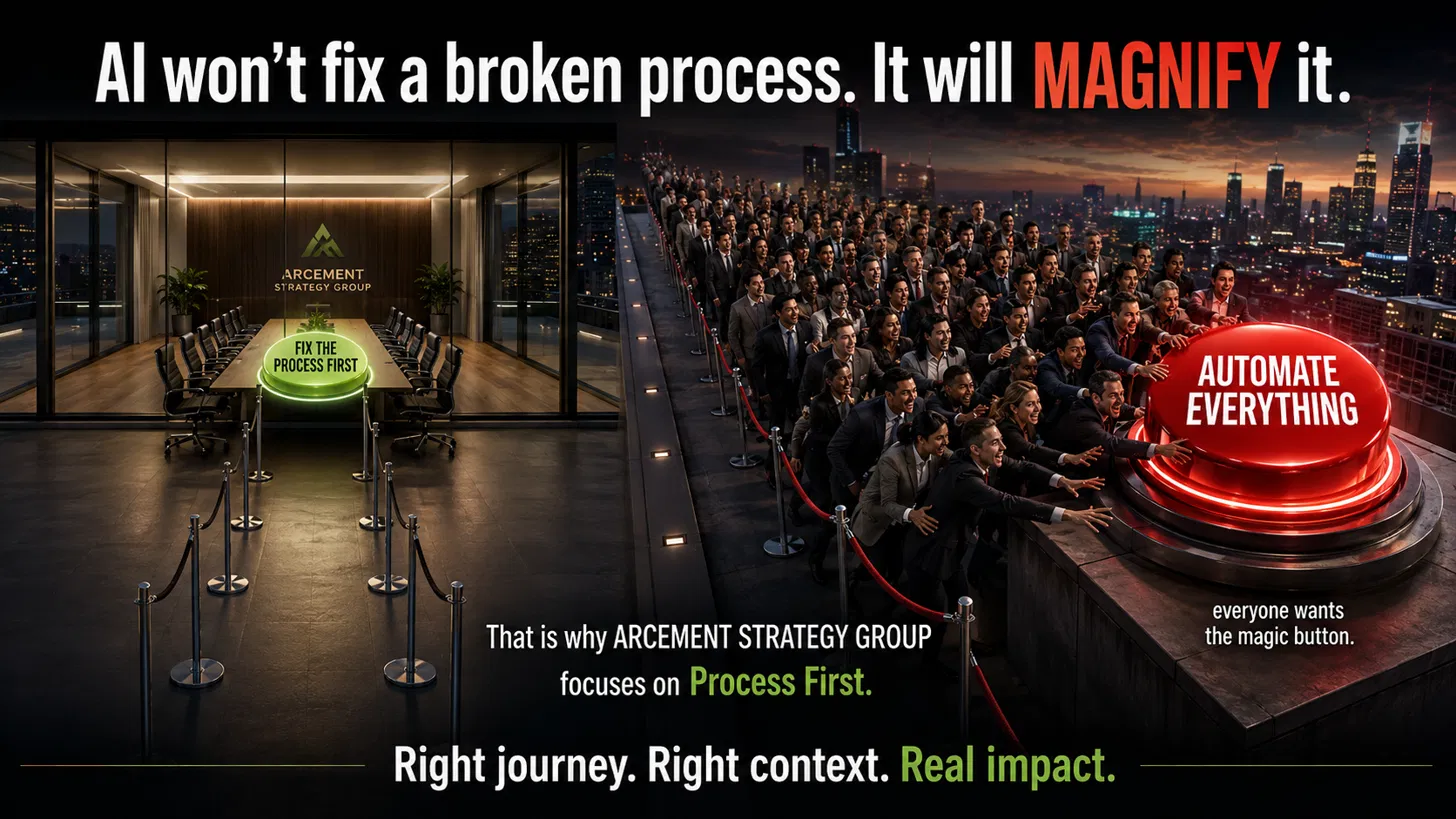
Technology scales whatever process already exists. When the process is clear and the people are prepared, AI can create real capacity and consistency. When they are not, it simply distributes the confusion faster.
Objections, answered.
Can't I just train my people harder?
Not into a process that was never defined. Training without a standard produces confident people doing inconsistent things. Define what good looks like first, and training becomes far more effective.
We already have a CRM.
Software is the third pillar, not the first. A CRM installed on top of an undefined process digitizes the confusion and makes it harder to change. Tools scale what exists.
Why not just hire someone good?
You should hire great people. But a great hire is an advantage, not a system. When critical knowledge, standards, and coaching practices are documented, the capability remains even when the employee eventually moves on.
Our business is different.
The content is different. The shape is not. A missed after-hours call at a plumbing company and an unanswered resident request in a public-works department are different situations built on the same operational failure: a need entered the organization, but no dependable process carried it forward.
We're too small for this.
Small operations are where undefined processes can cost the most, because there's no bench to absorb the disruption. If one person being out slows everything down, you're exactly who this is for.
Do not invest in another tool, training program, or major initiative until you know what is actually broken.
Start with a 30-minute discovery call. We'll identify the customer or resident journey worth examining, discuss the symptoms you're seeing, and determine whether a formal Customer Journey Audit is the right next step.
Book the Discovery CallNo pressure. No predetermined solution. We'll tell you honestly whether the next step is an audit, training, internal action, technology — or nothing at all.